


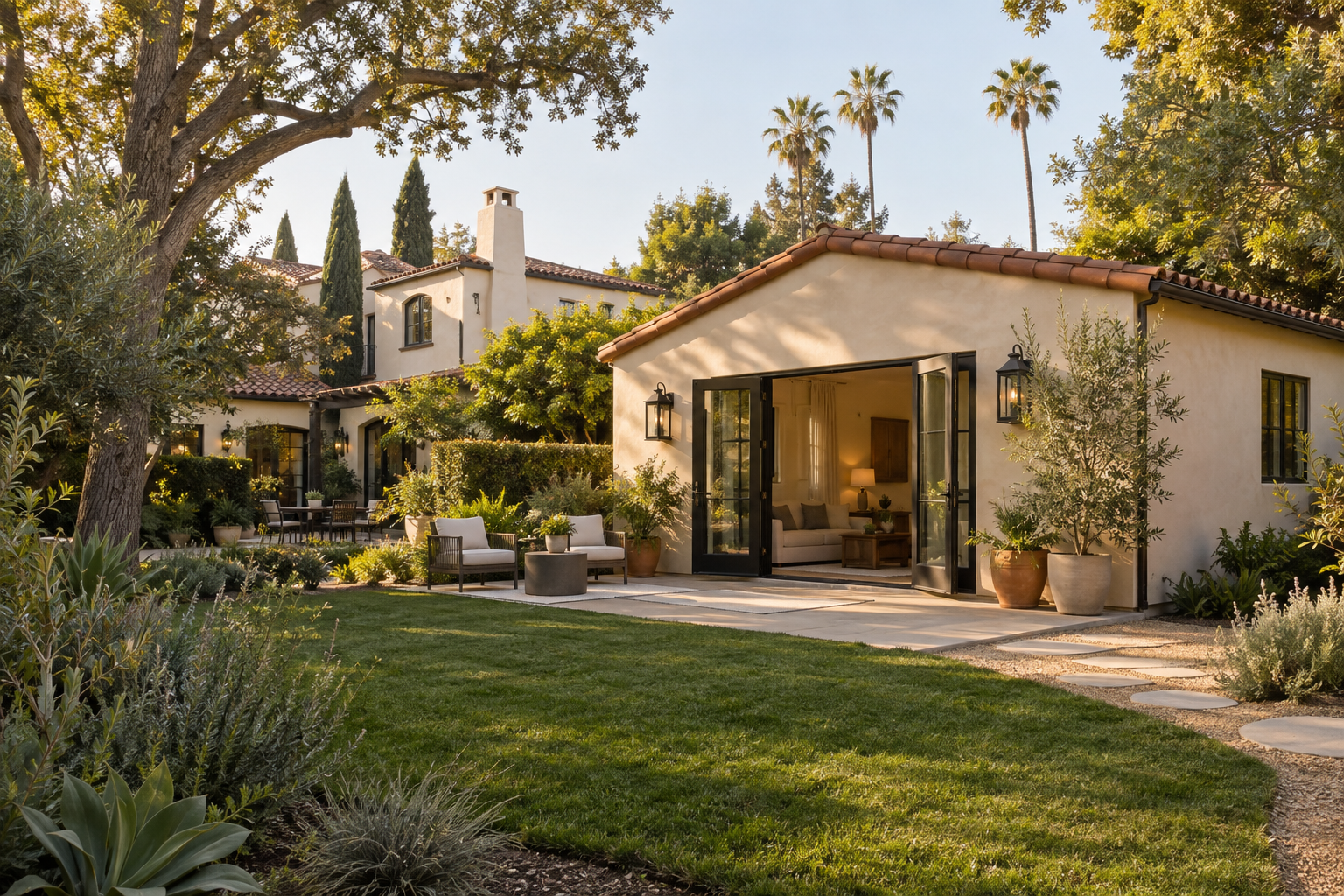
ADUs in the City of Los Angeles: How Permits Affect Value, and How to Legalize One
An Accessory Dwelling Unit (ADU) is a secondary living space on a single-family or multifamily lot, and whether it’s permitted changes almost everything about how it’s valued: a permitted ADU counts as real, financeable square footage that appraisers can support with comparable sales, while an unpermitted ADU is treated as unverified space that lenders and appraisers must discount or exclude. In the City of Los Angeles, homeowners with an unpermitted ADU now actually have two different paths to legalize it — and, as of mid-2026, one of them no longer requires setting aside an affordable housing unit in exchange.
What Counts as an ADU (and What’s a JADU)?
California state law (Government Code Sections 66310–66342, formerly Section 65852.2) is the foundation the City of LA’s own ADU rules build on. An ADU is a secondary dwelling unit — attached, detached, or converted from existing space like a garage — with its own kitchen, bathroom, and sleeping area. A Junior Accessory Dwelling Unit (JADU) is a smaller category: up to 500 square feet, built entirely within the walls of the existing single-family home, and it may share sanitation facilities with the main house.
The City of LA’s ADU Ordinance
The City of Los Angeles adopted its Accessory Dwelling Unit Ordinance (Ordinance No. 186,481) in December 2019, codified at Los Angeles Municipal Code Section 12.22A.33, covering ADUs, JADUs, and Movable Tiny Houses, according to the Los Angeles Department of Building and Safety. New, ground-up detached ADUs in the city are required to have solar panels, and fire sprinklers generally aren’t required unless the primary home already needs them. The city also runs a Standard Plan Program, where LADBS pre-approves architect- and engineer-designed plans to speed up plan check for common ADU layouts.
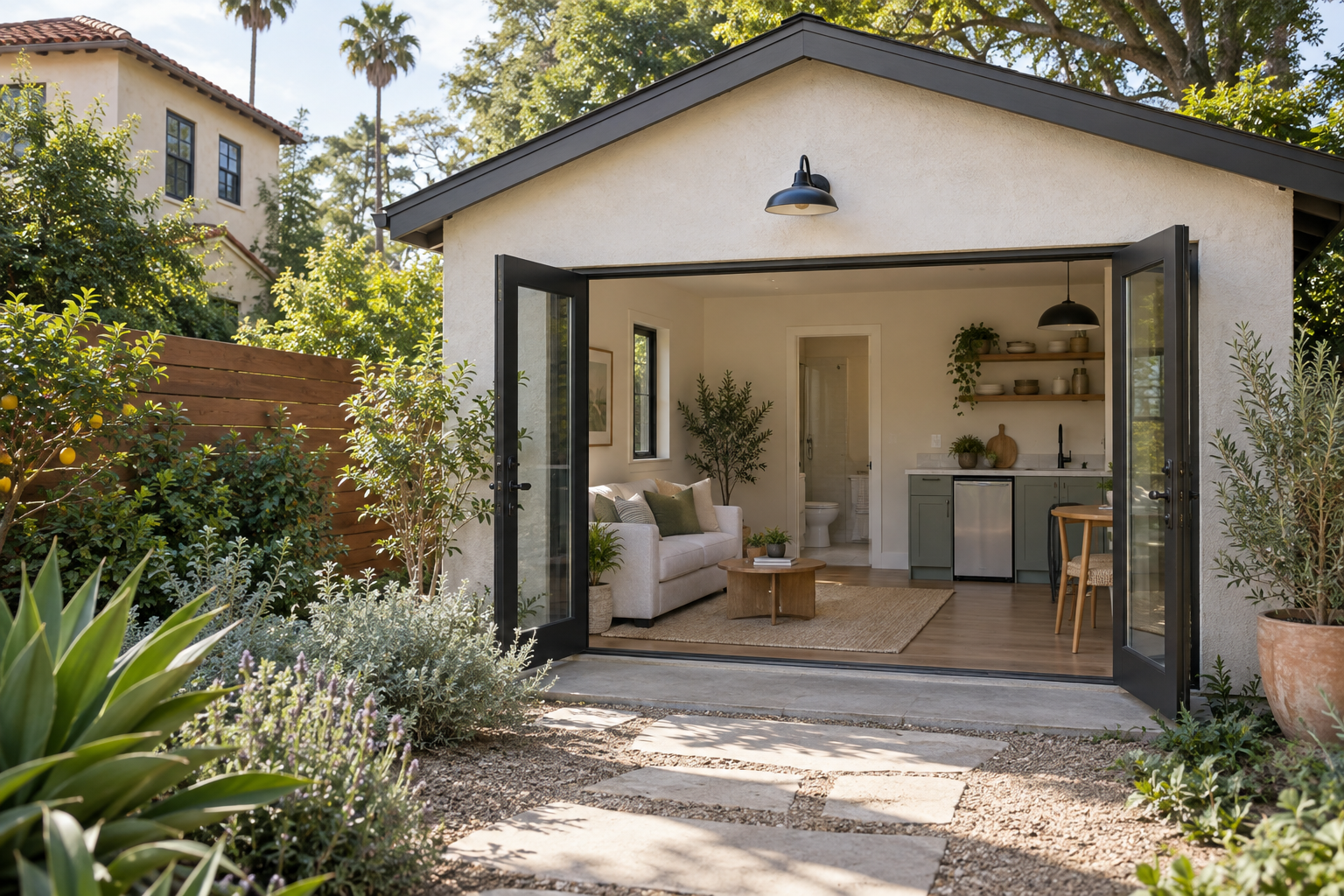
Permitted vs. Unpermitted ADUs: Why It Matters
A permitted ADU has gone through plan check and inspection with LADBS and has a signed-off final inspection on record. An unpermitted ADU — often an old garage conversion, a converted basement, or an addition built without ever pulling a permit — exists physically but has no official record confirming it meets current building, electrical, plumbing, or fire-safety standards.
That distinction affects a home sale in several concrete ways:
- Square footage and bedroom/bathroom counts. A permitted ADU can generally be counted and marketed as legitimate additional living space. An unpermitted one typically can’t be represented the same way, since there’s no official record to support it.
- Insurability. Some homeowner’s insurance carriers will decline to cover a property, or will exclude the unpermitted structure, once they know about it.
- Disclosure obligations. California law generally requires sellers to disclose known unpermitted work to buyers — it’s a material fact that affects a buyer’s decision, not something to leave off a transfer disclosure statement.
- Financing. As covered below, unpermitted ADUs face meaningfully stricter underwriting and appraisal requirements than permitted ones.
How Appraisers and Lenders Actually Treat Unpermitted ADUs
This is where permit status shows up most directly in dollars. Under Fannie Mae’s Selling Guide, a one-unit property with an ADU is still classified and underwritten as a one-unit property, but the appraiser is specifically required to describe the accessory unit and analyze its effect on value and marketability, with eligibility requiring “an analysis of at least one comparable property with the same use,” according to Fannie Mae’s Selling Guide.
In practice, that plays out very differently depending on permit status:
- A legal, permitted ADU generally needs the appraiser to find just one comparable sale involving a similar ADU to demonstrate the market recognizes and pays for that kind of space.
- An illegal or unpermitted ADU faces a much higher bar — Freddie Mac’s guidelines require the appraisal to include two comparable sales of properties with similarly unpermitted ADUs to prove market acceptance of the non-conforming space, and the lender must also confirm that homeowner’s insurance will still cover the property with the unpermitted unit disclosed.
If an appraiser can’t find comparable sales that support an unpermitted structure’s value — which is common, since most MLS data doesn’t clearly flag ADU permit status — the safest and most common outcome is that the unit gets valued at little to no contributory value, or excluded from the appraisal’s square footage entirely. In other words: an unpermitted ADU you spent real money building can appraise for close to nothing, even though a permitted equivalent might add substantial value. This is exactly why legalizing an existing unpermitted unit is usually worth the effort before you sell.
Two Ways to Legalize an Unpermitted ADU in the City of LA
Homeowners in the City of Los Angeles actually have two different programs available, and they work quite differently — one has been around since 2017, and the other is much newer.

Option 1: The Unpermitted Dwelling Unit (UDU) Ordinance
The city’s original path, the Unpermitted Dwelling Unit (UDU) Ordinance (Ordinance No. 184,907, effective May 17, 2017), is a voluntary legalization program administered by LA City Planning. A qualifying unpermitted unit can be legalized as long as it meets life-safety conditions — but this program requires the owner to provide at least one deed-restricted low- or moderate-income affordable housing unit for each unit legalized, according to LA City Planning’s UDU program page. For many homeowners, that affordability trade-off has made this program a hard sell.
Option 2: Streamlined Permitting Under AB 2533 (No Affordable Housing Requirement)
As of July 15, 2026, LADBS has a second, more direct option: streamlined permitting under Assembly Bill 2533, established in LADBS Information Bulletin P/BC 2026-161. Unlike the UDU Ordinance, this program does not require setting aside an affordable housing unit. To qualify, the unpermitted ADU or JADU must have been built before January 1, 2020, and meet the state’s definition of an ADU or JADU.
Here’s how it works:
- Optional third-party inspection. Before applying, the owner can choose to get a confidential inspection from a California-licensed contractor using the City of Los Angeles Substandard Checklist (Form AB2533-01) — this is informational only and doesn’t need to be submitted to LADBS.
- Life-safety standard, not full current code. The unit is evaluated against California Health and Safety Code Section 17920.3’s substandard housing standards — things like proper sanitation, safe electrical systems, adequate emergency egress windows, and structural soundness — rather than being required to meet every current building code as if it were new construction.
- No local fines or impact fees for qualifying units. LADBS’s bulletin specifically states that AB 2533 is intended to remove obstacles that previously deterred permitting, including local fines, impact fees, and the requirement to upgrade older units to meet current building codes.
- Standard permit and inspection fees still apply. This is an amnesty from penalties and full code-upgrade requirements, not a free process — you’ll still pay standard plan review, permit, and inspection fees, and any genuinely unsafe conditions identified will need to be corrected.
- Apply through ePlanLA or in person. Applications can be submitted online at ePlanLA or in person at any LADBS office, with the permit application specifically referencing AB 2533.
For most homeowners with a pre-2020 unpermitted unit, this AB 2533 pathway is worth exploring first, since it avoids the UDU Ordinance’s affordable housing set-aside. Units built on or after January 1, 2020 don’t qualify for AB 2533 and would need to go through standard permitting instead.
Frequently Asked Questions
Does an unpermitted ADU add value to a home in Los Angeles? It can, but far less reliably than a permitted one. Appraisers face a much higher standard of proof for unpermitted structures — Freddie Mac requires two comparable sales of similarly unpermitted properties — and without that support, the unit may be valued at little to no contributory value.
Do I have to provide affordable housing to legalize my unpermitted ADU in LA? Not necessarily. The city’s original UDU Ordinance does require a deed-restricted affordable unit per unit legalized, but if your ADU or JADU was built before January 1, 2020, you can instead apply through the newer AB 2533 streamlined permitting process, which doesn’t have an affordable housing requirement.
What’s the difference between the UDU Ordinance and AB 2533 legalization? The UDU Ordinance is a voluntary local program requiring an affordable housing set-aside. AB 2533 is a state-mandated process (implemented locally by LADBS) for units built before January 1, 2020 that evaluates the unit against life-safety standards rather than full current code, with no affordable housing requirement.
Can I legalize an ADU built after January 1, 2020 without a permit? AB 2533’s streamlined process specifically applies to units built before January 1, 2020. A unit built after that date without permits would need to go through the standard permitting and legalization process instead.
Sources
- Los Angeles Department of Building and Safety — Accessory Dwelling Unit (ADU)
- LADBS Information Bulletin P/BC 2026-161 — Streamlined Permitting of Unpermitted Dwelling Unit as ADU/JADU Under AB 2533
- Los Angeles City Planning — Unpermitted Dwelling Units (UDU) Program
- Fannie Mae Selling Guide — General Property Eligibility (B2-3-01)
This article is for general educational purposes and isn’t a substitute for advice from a licensed contractor, appraiser, or LADBS about your specific property.
About The Bienstock Group:


The Bienstock Group, led by Sheri Bienstock, is an expert real estate group in Los Angeles, Hancock Park, and Miracle Mile. Sheri is committed to her clients and will invest all her effort to get you the best results possible. Sheri has 235+ five-star reviews on Zillow, and has been ranked #1 listing agent in 90036 since 2009 and in Hancock Park since 2016.